
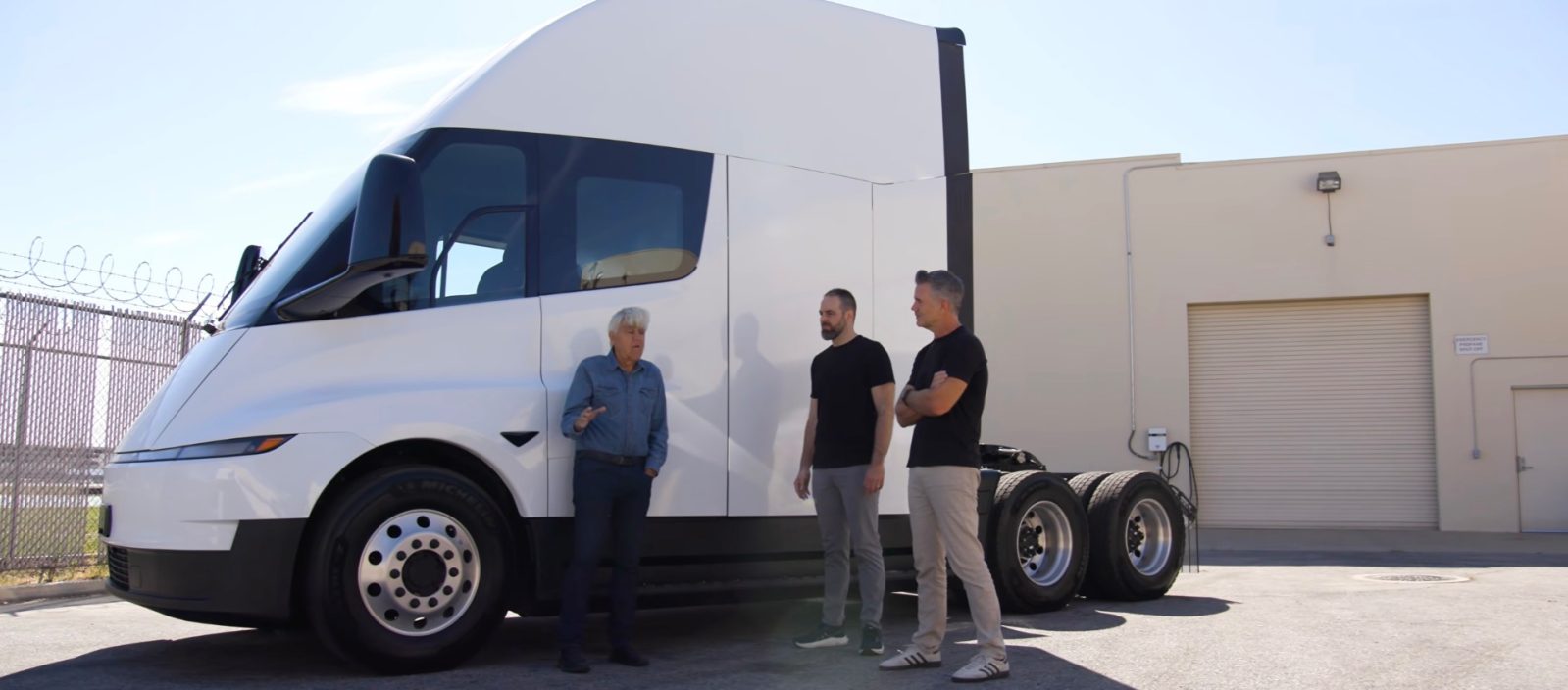
Tesla Semi program lead Dan Priestley took Jay Leno on an extensive tour of the production-intent electric truck, revealing significant engineering details — including 1,000 lbs of weight savings that bring the 500-mile version to payload parity with diesel trucks.
The episode is packed with new technical information about the powertrain architecture, charging capabilities, and production readiness as Tesla prepares to ramp its dedicated Semi factory outside Reno, Nevada, to 50,000 units per year.
Aerodynamics, weight, and the payload problem solved
The biggest knock against the Tesla Semi has always been weight. An electric truck carrying a massive battery pack inevitably sacrifices payload capacity — or so the argument went.
Priestley confirmed that Tesla has cut approximately 1,000 lbs from the truck since its earlier iterations. Combined with a 2,000 lb federal weight exemption for electric vehicles, the 500-mile Long Range version now achieves effective payload parity with conventional diesel Class 8 trucks. Customers are already hauling 45,000 lb payloads daily.
The aerodynamics have improved too. Priestley said the drag coefficient saw a 7% improvement over what Tesla previously demonstrated, bringing the Cd down to approximately 0.4.
“We said the drag coefficient was lower than a Bugatti Veyron, right? And we’ve actually improved on that… it’s a 7% improvement on the aero efficiency from before,” Priestley said.
There’s also a practical cabin update: the windows now feature “drop glass” that rolls down fully, replacing the older single-pane design that only tilted out. That matters for truckers who regularly need to pass clipboards or access gate terminals at shipping yards.
The Standard Range version, rated at 325 miles with a starting price around $260,000, achieves a smaller footprint by removing one of three parallel battery packs and shortening the wheelbase. The result is a turning radius comparable to a Tesla Model 3 or Model Y — remarkable for a Class 8 truck.
A clever dual-axle powertrain with deep Cybertruck roots
Perhaps the most interesting engineering detail is the powertrain architecture. The Tesla Semi does not use a multi-speed transmission. Instead, it uses two distinct rear axles with different gearing purposes.
The front “torque axle” is geared specifically for heavy acceleration and hill climbs. Once the truck reaches highway cruising speed, this axle completely disengages internally to eliminate mechanical drag. The separate “efficiency axle” then handles all highway cruising on its own.
This approach neatly solves one of the fundamental challenges of electric trucks: the tradeoff between low-speed torque for pulling heavy loads up grades and high-speed efficiency for long-haul highway driving.
The Semi also shares a surprising amount of its architecture with the Cybertruck. The two vehicles use the same battery cell type, the same stator and inverter designs, and the same 48-volt low-voltage architecture — which Priestley said significantly reduces wiring mass compared to the traditional 12-volt systems used across the industry.
The steering system uses beefed-up Cybertruck electric assist actuators rather than the heavy hydraulic assist systems found in conventional trucks, though Tesla retained a physical steering shaft rather than going full steer-by-wire. The braking system uses standard air friction brakes, but they are electronically controlled via brake-by-wire to interface seamlessly with standard pneumatic commercial trailers.
1.2 MW charging, million-mile battery, and electric refrigeration
On the charging front, Priestley confirmed the Semi can charge at 1.2 megawatts, recovering 60% of its battery — up to 300 miles of range — in just 30 minutes. Tesla recently opened its first customer-facing Megacharger station in Ontario, California, with plans to deploy 46 stations by early 2027.
The battery pack is structurally integrated low into the chassis and designed to last a million miles in its original duty cycle — a critical economic selling point for fleet operators who typically plan vehicle lifecycles around 500,000 to 1,000,000 miles.
One of the more practical revelations: Tesla is using Cybertruck power electronics to route electrical power directly from the truck to trailer-mounted refrigeration units, eliminating the need for a separate diesel “pony motor.”
“Why do we have an electric truck that is then also pulling a diesel engine on the back of it? It doesn’t make sense. And also they’re really noisy. They actually consume a lot of fuel,” Priestley said. “So we’re actually using the same power electronics that we use from the Cybertruck to power a refrigerated trailer unit.”
Tesla also flagged automated conductive charging, where the truck drives over a pad without manual plug-ins, as a future opportunity – a technology Tesla is already working on for its Cybercab.
Fleet data, economics, and the path to 50,000 units
Tesla’s test fleet has now accumulated over 13.5 million miles, with the lead truck approaching 440,000 miles. The fleet maintains 95% uptime, and for the breakdowns that do occur, 75-80% of trucks are returned to the customer within 24 hours — nearly half within an hour.
On economics, Priestley said the Semi is 50% cheaper to operate per mile on energy costs in California compared to diesel. Nationally, the total cost of ownership is nearly 20% cheaper per mile. Those numbers align with Tesla’s quoted price of $290,000 for the Long Range version — well below the industry average of $435,000 for a zero-emission Class 8 truck according to California’s HVIP program data.
“The economics are right. The product is ready. We have the factory standing up, but we have ample demand,” Priestley said.
The dedicated Semi factory outside Reno, Nevada, is targeting a capacity of 50,000 units per year. Tesla has been ramping toward volume production at the facility, though the program has experienced several timeline delays over its history.
The competitive landscape is thinning. Nikola went bankrupt. Daimler’s Freightliner eCascadia and Volvo’s electric trucks are shipping in limited numbers but at higher price points and lower range. The field is more open for Tesla than it was two years ago, if the company can actually execute on production.
Electrek’s Take
Top comment by Philip234
It's magic. Oh, wait, it's 500 miles x 2,000 cycles = 1,000,000 miles. Most modern NMC battery packs have a 1,500 - 2,500 cycle life. Fun fact, the new BMW iX3 or Volvo EX60 have >600,000 mile packs by the same measure.
The Semi does not suffer from excessive calendar aging and being held at a high charge rate for long periods because they are continuously used. Tesla is to be sure employing aggressive thermal management, the latest 4680 cell, and a decent buffer to get you there.
This Jay Leno’s Garage episode is the most detailed technical walkthrough of the Tesla Semi we’ve seen to date, and the engineering story is genuinely impressive.
The dual-axle powertrain approach, using a dedicated torque axle that disengages at highway speed, is an elegant solution to a problem that has plagued electric truck design. The extensive parts-sharing with Cybertruck makes economic sense and should help with supply chain scale, though it also means the Semi’s production timeline is partially dependent on Cybertruck component availability.
The payload parity claim is the headline that matters most for fleet buyers. The weight penalty has been the single biggest argument against battery-electric long-haul trucking, and if Tesla has genuinely closed that gap with a combination of weight reduction and the federal EV exemption, it removes a major barrier to adoption.
We remain cautious about timelines. Tesla originally promised Semi production in 2019, and the program has been delayed repeatedly since then. The 50,000-unit annual capacity target is ambitious for a truck that has never been manufactured at scale. But the product itself, based on the engineering details revealed here, looks ready.


FTC: We use income earning auto affiliate links. More.




Comments